Cyber Pandemic: The Systemic Risk Hiding in Our Digital Dependence
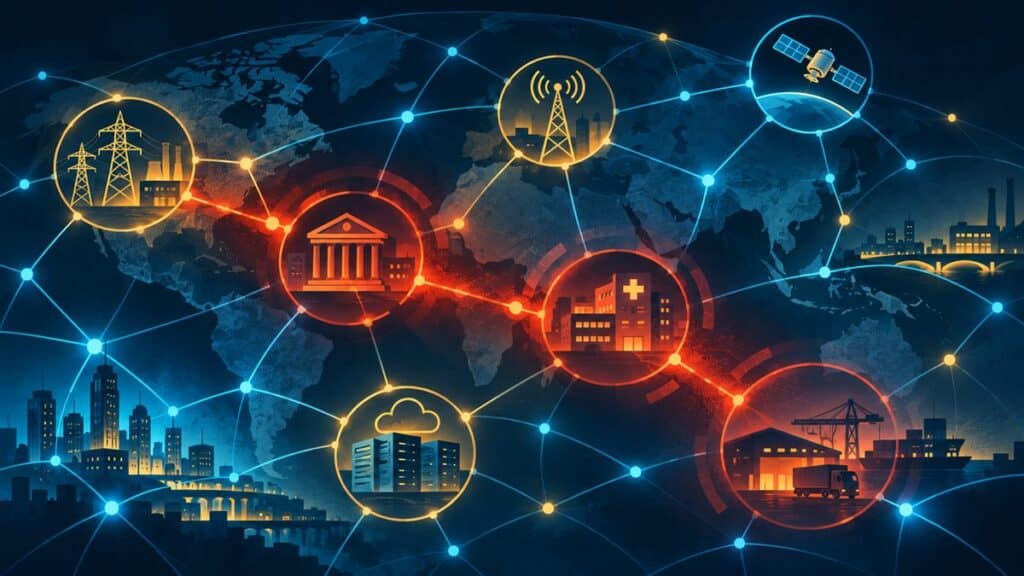
A hospital cannot see patient records. A port cannot release containers. A bank cannot reconcile payments. A factory is running, but its suppliers are invisible. These failures do not need to begin in the same country, or even in the same industry.
This is the useful meaning of a cyber pandemic: not a mysterious prediction and not necessarily one piece of malware infecting the planet, but a digital disruption that crosses organizational and national boundaries because the systems beneath modern life are deeply connected.
The metaphor is imperfect. Software does not behave exactly like biology. Yet it points to a real engineering problem: local failures can become systemic when many organizations depend on the same cloud platforms, identity providers, software libraries, telecom networks, payment rails and operational technology.
In this article
What “cyber pandemic” actually means
The phrase is older than the viral narratives surrounding it. In 2012, former European Commission official Robert Madelin described a hypothetical global cyber pandemic as an accidental, criminal or state-driven disruption spreading through networked systems and affecting communications, transport, energy and supply chains. His central concern was concentration: the more shared nodes that fail, the wider the consequences.
That distinction matters. A cyber pandemic could take several forms:
- a self-propagating exploit that moves rapidly across vulnerable systems;
- a software supply-chain compromise inherited by thousands of customers;
- a coordinated attack on several critical sectors;
- or a failure at a highly concentrated technology provider that creates cyberattack-like consequences without an attacker.
The cinematic image of every screen going dark at once is misleading. Systemic crises are usually uneven. Some services fail, others slow down, and many continue operating with degraded data or manual workarounds. The danger lies in second- and third-order effects: a payment outage becomes a logistics delay; a logistics delay becomes a production stoppage; a communications failure complicates recovery from both.
Why the risk is rising
Digitization has created extraordinary efficiency, but efficiency and resilience are not the same thing. We have reduced duplication, standardized platforms and connected workflows end to end. Each move makes economic sense in isolation. Collectively, they can create hidden common points of failure.
The World Economic Forum’s Global Cybersecurity Outlook 2026 describes a risk environment shaped by rapid AI adoption, geopolitical fragmentation and widening differences in cyber capability. In its survey, 87% of respondents identified AI-related vulnerabilities as the fastest-growing cyber risk during 2025, while 64% of organizations said they were accounting for geopolitically motivated attacks such as espionage or disruption of critical infrastructure.
AI changes the tempo on both sides. Defenders can analyze alerts, find anomalies and automate response faster. Attackers can also scale reconnaissance, social engineering, vulnerability discovery and adaptation. This does not create an all-powerful autonomous hacker. It compresses time. The interval between exposure and exploitation becomes shorter, while defenders still operate through approval chains, vendor dependencies and incomplete inventories.
The weakest organizations also affect the strongest. A well-defended enterprise may still depend on a small vendor with limited security staff, an unsupported device in a physical facility, or a public agency whose services cannot simply be switched off. Cyber inequity becomes systemic risk when less-resourced nodes sit inside everyone else’s supply chain. This article is available to registered readers. Sign in to continue, or register with a basic subscriber account.Continue reading after sign in.