Investing
Investing with technical discipline and business depth.
My investing work is built around a techno-funda lens: blending technical market structure with fundamental business analysis before forming conviction.
The investing lens
I do not look at investing as price prediction. I look at it as a study of systems: businesses, industries, incentives, capital allocation, competitive advantage, technology shifts, and human behavior.
The best opportunities often appear when fundamentals, price behavior, volume action, market structure, and valuation begin to point in the same direction. My work is to understand that convergence with patience, skepticism, and a clear process.
Techno-funda investing
Techno-funda investing blends two views that are often kept separate: the technical behavior of price, volume, trend, relative strength, and market participation, and the fundamental quality of the underlying business.
Fundamentals help me understand what I may want to own. Technicals help me understand whether the market is beginning to recognize it, ignore it, distribute it, or reject it. I want both evidence streams to improve the quality of decision-making.
Process before conviction
Conviction should come from process, not excitement. I prefer to study companies through repeatable questions: business quality, industry structure, management execution, balance sheet strength, growth runway, cash generation, and risk.
AI is now becoming part of that process. It helps me organize research, compare patterns, summarize filings and commentary, build watchlists, and challenge my assumptions. The final judgment still has to remain human.
What I study
01Business quality
Moats, industry structure, pricing power, operating discipline, customer behavior, and the durability of earnings.
02Technology leverage
How software, data, AI, automation, platforms, and digital distribution change the economics of a company.
03Capital discipline
Valuation, cash flow, reinvestment runway, balance sheet strength, dilution, and margin of safety.
04Behavior and patience
Position sizing, thesis tracking, emotional discipline, error correction, and staying with a good process.
How I use AI in investing
AI is useful when it improves the quality and speed of research without weakening judgment. I use it as a thinking partner for summaries, pattern recognition, comparison, checklist discipline, and scenario exploration.
The danger is outsourcing conviction. I prefer to use AI to ask better questions, surface blind spots, and structure the research trail so that decisions remain grounded and reviewable.
With gratitude
My investing journey has been shaped by many generous teachers, thinkers, and practitioners. I remain grateful for the inspiration and learning I have drawn from Vivek Mashrani, Roopesh Merani, Brian Feroldi, Mark Minervini, Steve Nison, William O’Neil, Van Tharp, and several more.
Investing Resources
Investing resources built or curated by Janmejay Rathore. Sign in to access the active resources.
A structured equity research platform for market context, watchlists, stock discovery, technical screens, and portfolio workflows. Register to create your research workspace.
Sign in to access GPT MarketAtlas Equity IntelligenceEvaluate companies through business quality, technology leverage, valuation discipline, and long-term compounding potential.
Sign in to accessInvesting writing
Notes on investing, business quality, markets, technology change, capital allocation, and long-term compounding.
-
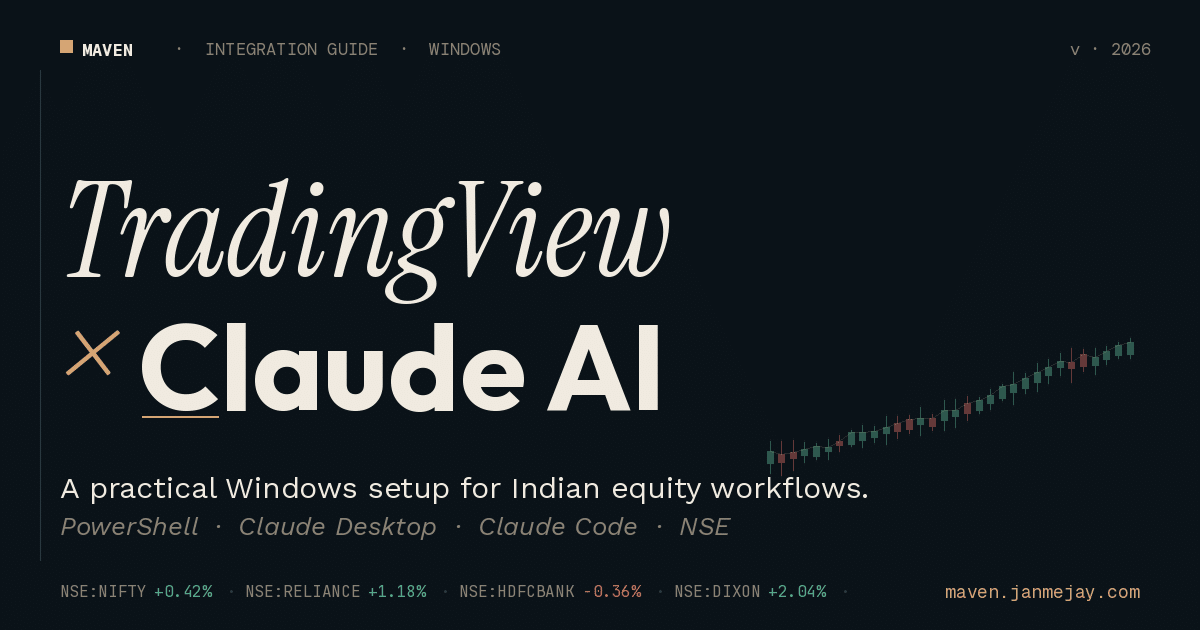
Connect TradingView Desktop to Claude on Windows: Setup Guide for Indian Markets
Turn your TradingView charts into a live, queryable surface for Claude. Ask in plain English, get analysis, scoring, Pine Script edits, and morning briefs…