Past Life Regression Therapy: Understanding the Past to Become More Present

Sometimes our reactions seem bigger than the situation in front of us.
We may experience an unexplained fear, an unusually strong connection with someone, a recurring relationship pattern, a sense of déjà vu, a persistent emotional block or a feeling that there is something deeper behind what we are experiencing.
We understand the problem intellectually. We may even know what we need to do.
And yet, something within us continues to respond differently.
Past Life Regression Therapy, or PLRT, is a guided process for exploring these deeper patterns through the subconscious mind.
The purpose is not simply to discover who you may have been in another lifetime.
The purpose is to understand what you may still be carrying into this one.
What Is Past Life Regression?
Past Life Regression is a guided process in which you enter a deeply relaxed and focused state and allow impressions, emotions, images, memories or intuitive knowing to emerge from deeper levels of consciousness.
Some people experience vivid scenes.
Some hear words, conversations or names.
Some primarily experience emotions.
Others simply have a strong sense of knowing something without being able to explain how they know it.
There is no single correct way to experience a regression.
For one person it may unfold almost like a movie. For another, the most important part of the experience may be one emotion, one sentence or one sudden realization.
The objective is not to force an experience.
It is to create the space in which something meaningful can emerge.
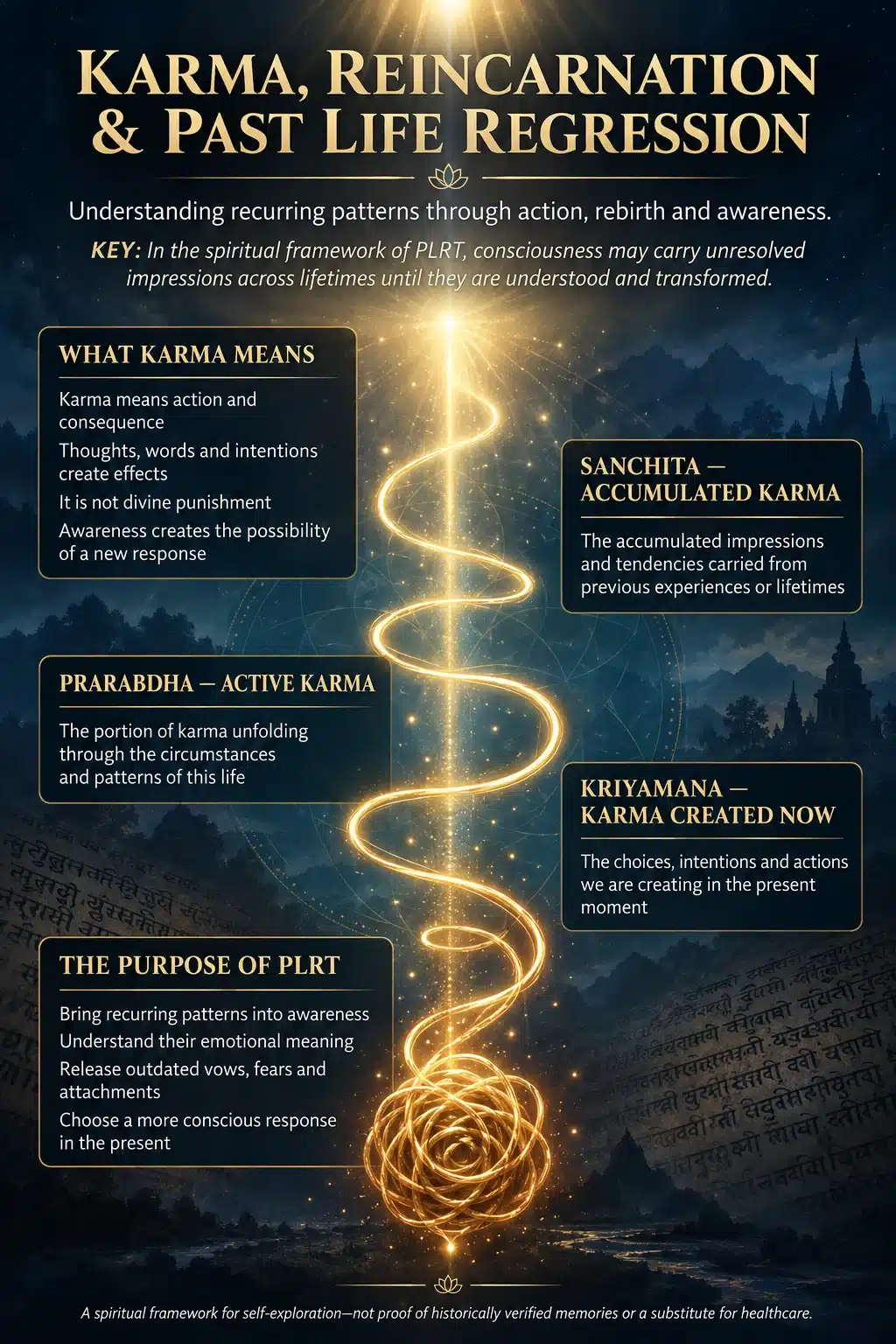
Why Might Past Life Regression Work?: Understanding Patterns Through the Law of Karma
This could explain two complementary perspectives:
- Therapeutically, relaxed focus may help subconscious emotions, beliefs, memories and symbolic narratives become accessible.
- Spiritually, karma can be understood as cause and effect—not punishment—with actions, intentions, attachments and unresolved experiences creating tendencies that may continue across lifetimes.
- PLRT does not erase karma or change the past. It may help someone understand the pattern, accept responsibility, release outdated vows or conclusions, and respond differently in the present.
- This would remain clearly framed as a spiritual interpretation rather than a scientifically verified mechanism.
Applications of Past Life Regression Therapy
Past Life Regression may be explored when a present-life issue feels deeper than its obvious circumstances, when a pattern keeps repeating despite conscious effort, or when there is a strong inner sense that something needs to be understood.
Emotional
Relationships with Family, Friends or Rivals
Soul Connections, Conflicts & Breakups
Significant Life Changes
Loss, Grief & Emotional Attachment
Career Crossroads
Spiritual
Reconnect with Spiritual Abilities
Explore Life Purpose
Explore Spiritual Guidance
Connect with the Higher Self
Understand or Reconcile the Fear of Death
Mental & Emotional Patterns
Fears, Phobias & Unexplained Aversions
Anxiety & Recurring Negativity
Limiting Beliefs & Mental Blocks
Obsessive or Compulsive Patterns
Déjà Vu, Intuitions & Recurring Dreams
Body & Mind Connections
Recurring Body Awareness or Sensations
Emotional Associations with Illness or Injury
Chronic Stress Patterns
Patterns Around Food or Body Image
Birthmarks or Unusual Physical Associations
When Should You Consider Past Life Regression?
I do not recommend Past Life Regression merely because past lives sound interesting.
Curiosity is perfectly natural, but a therapeutic regression usually becomes more meaningful when there is a question behind the curiosity.
You may consider a session when you find yourself asking questions such as:
Why does this particular relationship affect me so deeply?
Why does the same pattern keep repeating in my life?
Why do I have this fear when nothing in my present life seems to explain it?
Why do I feel an immediate attraction or aversion toward a person or place?
Why does a particular dream or scene keep returning?
Why do I understand something intellectually but still cannot release it emotionally?
Or perhaps there is no obvious problem.
Sometimes there is simply a strong inner feeling that this is the right time to explore deeper.
That too can be meaningful.
What Past Life Regression Is Not
Past Life Regression is not fortune telling.
It is not about predicting your future.
It is not about proving that you were a famous historical personality.
And it should not become an escape from the responsibilities and lessons of the life you are living now.
In fact, I see its purpose almost as the opposite.
We go into the past only to become more free in the present.
Whether you understand what emerges as an actual past-life memory, a symbolic story created by the subconscious mind, or a spiritual experience is ultimately less important than what the experience helps you understand and transform today.
Do I Need to Believe in Reincarnation?
No.
You do not need to arrive with a fixed belief in reincarnation.
But you do need a certain degree of openness.
There is an important difference between belief and openness.
Belief says: “This must be true.”
Disbelief says: “This cannot be true.”
Openness says: “Let me experience what comes and understand what it may be trying to show me.”
That is usually the most useful state in which to enter a regression.
What Happens During a Past Life Regression Session?
The regression does not begin with hypnosis.
It begins with a conversation.
We first understand what is happening in your present life.
What brought you here?
What issue would you like to explore?
How does it affect you today?
What have you already tried?
Are there particular people, relationships, dreams, fears or experiences connected with it?
And most importantly:
What would change for you if this issue became clearer or lighter?
The initial conversation also helps determine whether Past Life Regression is appropriate for you at this time. We may discuss your physical and emotional wellbeing, relevant treatment history, current support systems and expectations from the session. If another form of support would be safer or more useful, I may recommend that first.
Once we have clarity around the intention of the session, the experiential part begins.
You are guided gradually into a deeply relaxed and focused state.
You Remain Aware and in Control
One of the biggest misconceptions about hypnosis is that you become unconscious or lose control.
That is not how I approach regression.
You remain aware.
You can speak with me.
You can describe what you are experiencing.
You can choose not to explore something.
And you can stop the process whenever you want.
A good regression is not about losing control.
It is about temporarily allowing the analytical mind to become quieter so that deeper material can emerge.
What Will I See During a Regression?
There is no standard experience.
You may see places, people or events.
You may hear words or conversations.
You may feel emotions very strongly.
You may experience sensations in the body.
Or you may simply know something.
Some people initially worry:
But seeing is only one way the deeper mind communicates.
An emotion can sometimes reveal more than an elaborate visual scene.
A single sentence can sometimes contain the entire insight required from the session.
So there is no need to perform.
No need to manufacture images.
And no need to try too hard.
The process works better when you allow rather than force.
The Most Important Part: Connecting It to Your Present Life
This is where regression becomes meaningful.
Simply experiencing another lifetime may be fascinating, but fascination alone is not therapy.
We explore questions such as:
What happened?
What emotions were created?
What conclusion did you draw from that experience?
Did you make an inner promise or vow?
Did a relationship remain unresolved?
What fear or belief might have been carried forward?
And how might that pattern be expressing itself in your present life?
Sometimes an old conclusion may have been completely appropriate for another situation, another time or another perceived lifetime.
But it may no longer serve you now.
“I will never trust anyone again.”
“Love always ends in pain.”
“I must always remain in control.”
“It is dangerous to be visible.”
“I must protect everyone.”
“I should never become vulnerable again.”
The circumstances that created that belief may be gone.
But the emotional imprint can continue.
The work then becomes less about the past and more about creating a different relationship with the present.
Integration After the Session
A regression session does not necessarily end when you open your eyes. Insights, emotions and connections may continue to unfold over the following days or weeks.
After the session, give yourself some quiet time. You may wish to journal what emerged, notice related dreams or emotions, and observe how the old pattern appears in everyday life.
The value of regression lies not only in what you experience, but in how you integrate that understanding—through new choices, healthier boundaries, greater self-compassion or a different response to familiar situations.
Preparing Before Booking a Session
The most important preparation happens before you arrive.
You do not need previous experience with meditation, hypnosis or spiritual practices.
But I encourage you to reflect on a few questions.
1. What Is Bringing Me Here?
Try not to begin with:
“I want to know who I was.”
Instead ask:
“What would I like to understand about my life today?”
The clearer the present-life question, the more useful the regression can become.
2. Why Now?
Sometimes we carry an issue for years but suddenly feel ready to explore it more deeply.
Ask yourself:
Why does this feel important at this point in my life?
There does not have to be a dramatic answer.
Even an intuitive feeling that the time is right can be enough.
3. What Pattern Would I Like to Understand?
Before the session, notice recurring patterns around relationships, fear, anger, trust, loss, control, career, money, self-worth, spirituality, or other areas important to you.
Do not try to determine the past-life cause yourself.
Simply notice what is happening now.
4. Think About Important People
Sometimes the strongest patterns appear through relationships.
You may want to reflect on people toward whom you feel unusually strong love, attachment, responsibility, anger, fear, resentment, familiarity, or unexplained connection.
Again, there is no need to conclude that you knew them in a past life.
Just notice the emotional pattern.
5. Notice Dreams, Déjà Vu and Recurring Images
If you have repeatedly experienced a particular dream, place, historical period, image or unexplained sense of familiarity, make a note of it.
Do not research it excessively before the session.
Sometimes too much information encourages the conscious mind to construct a story around it.
6. Avoid Creating Expectations
Do not decide beforehand:
“I must have been this person.”
“I must meet this particular soul.”
“I must see a certain lifetime.”
“I must get an answer to this exact question.”
Come with an intention.
But leave the experience open.
7. Come Rested
Try to get adequate sleep before the session.
Avoid arriving after an exhausting day if possible.
Eat normally and stay hydrated.
Avoid alcohol or recreational intoxicants before the session.
You want your mind to be relaxed, clear and naturally receptive.
What If I Am Afraid of What I Might Discover?
This is a very natural concern.
Sometimes emotionally intense experiences can arise during regression.
But the purpose is not to force you through traumatic scenes.
An experience can be approached from a distance.
It can be slowed down.
It can be observed rather than relived.
And you remain able to communicate throughout.
A regression should take place within a feeling of safety, trust and control.
Where appropriate, we may first establish an inner sense of safety—a calming place, image or feeling you can return to if the experience becomes overwhelming.
The objective is not to suffer through the past again.
It is to understand it differently.
How Many Sessions Will I Need?
There is no fixed answer.
For some people, one session brings considerable insight.
For others, the first session may largely be about learning how to relax, trust the process and communicate from a deeper state.
A complex issue may involve several layers or several experiences.
I therefore prefer not to promise:
“One session will solve your issue.”
Healing does not always follow our calendar.
Sometimes one insight changes everything immediately.
Sometimes the understanding continues unfolding over the following days or weeks.
Both are valid.
When Past Life Regression May Not Be Appropriate
PLR is only one modality.
It is not necessarily the right approach for every person, every issue or every stage of life.
There may be times when counselling, psychotherapy, medical treatment, hypnotherapy focused on the present life, meditation, energy healing or another modality is more appropriate.
If you are currently experiencing significant anxiety, depression or another mental-health condition, please consult your psychiatrist, psychologist or treating clinician before booking a session. Past Life Regression should not replace evidence-based mental-health care and may not be appropriate during an acute crisis or when symptoms are severe or unstable. It should not be undertaken in cases involving active psychosis except under the direction of an appropriately qualified mental-health professional.
I also believe that regression should never be forced simply because someone else thinks you should experience it.
You should want to explore it yourself.
Your readiness matters.
Your intention matters.
And timing matters.
The Question Is Not “Who Was I?”
The question that interests me more is:
What am I carrying?
What fear?
What attachment?
What unfinished emotion?
What belief?
What promise?
What pattern?
What lesson?
And eventually:
Do I still need to carry it?
Past Life Regression is ultimately not about becoming fascinated with another lifetime.
It is about becoming more conscious in this one.
The past becomes useful only when it helps us live with greater awareness, compassion and freedom in the present.
Thinking About a Past Life Regression Session?
Before requesting a session, spend a little time with these three questions:
What would I like to understand?
Why does it feel important now?
What would change in my present life if I gained clarity around it?
You do not need perfect answers.
Sometimes the question itself is the beginning of the journey.
Important Note
Past Life Regression is offered as a complementary modality for personal development, self-exploration and spiritual exploration. It is not a substitute for medical treatment, psychiatric treatment, psychotherapy or other professional healthcare where these are required. Experiences arising during regression should not automatically be considered historically verified memories.