Pranic Healing: Working With Energy to Support the Body’s Natural Balance
Energy healing · Complementary care
A grounded guide to what Pranic Healing is, when it may be useful, and how to prepare for a session.
Sometimes the body is receiving the right care, the mind understands what is happening, and yet we still feel depleted, heavy or slow to recover.
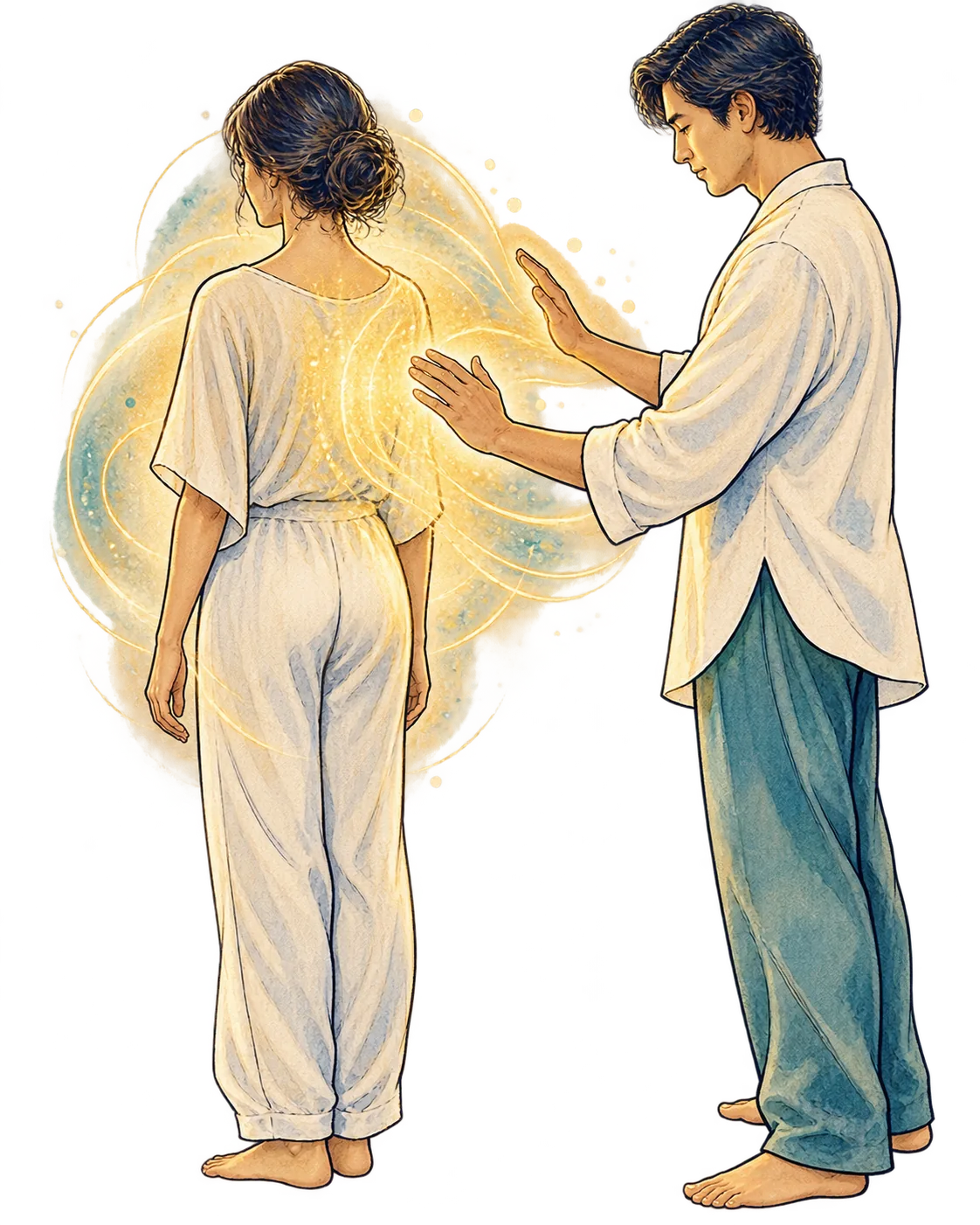
Pranic Healing is a non-touch energy-healing modality that works with the idea that the physical body is surrounded and interpenetrated by an energy field.
The intention is not to replace the body’s own intelligence.
It is to support it.
What Is Pranic Healing?
Prana means life energy. Different traditions have used different words for this idea—chi, ki, vital energy or life force.
Pranic Healing, as systematised by Master Choa Kok Sui, is based on the view that disturbances may first appear in the energy body before they become fully visible in the physical body, and that the condition of this energy field can influence wellbeing.
A practitioner does not touch or massage the body. The work is usually done with the hands at a short distance from the person.
The basic movement is simple to understand:
- Cleanse congested, depleted or unwanted energy.
- Energise the relevant areas with fresh prana.
- Stabilise the projected energy so the effect can settle.
From this perspective, the healer is not “doing the healing” to another person. The aim is to improve the energetic conditions in which the person’s own recovery and self-regulation may take place.
Belief is not a prerequisite
You Do Not Have to Convince Yourself.
You do not need to arrive with unquestioning faith in Pranic Healing. Curiosity is enough.
You can remain discerning, notice your own experience and decide for yourself whether the session was useful. Openness does not mean abandoning critical thinking. It simply means allowing the experience to unfold without trying to manufacture—or prevent—a particular result.
The underlying idea
Two Principles Behind the Practice
The body has a capacity for self-recovery
A cut closes. A bruise fades. The nervous system settles after a shock. Healing is already an intelligence within the body.
Life energy may support that recovery
Pranic Healing works with the belief that increasing and balancing available energy can help catalyse the body’s natural processes.
These are principles within the Pranic Healing system. The proposed energy mechanisms are not established medical science, and experiences and outcomes vary.
When Might You Consider Pranic Healing?
I see Pranic Healing as supportive care rather than a substitute for diagnosis or treatment.
It may be worth exploring when you want gentle, non-touch support alongside the practical steps you are already taking—especially when stress, emotional strain or a sense of energetic depletion is part of the picture.
Physical recovery
As complementary support during recovery from illness, injury or a medical procedure, with the knowledge of your treating clinician where appropriate.
Stress & fatigue
When you feel persistently drained, tense or unable to settle, and would like a quiet practice that supports relaxation.
Emotional heaviness
During periods of grief, relationship strain, change or emotional overload—without treating energy work as a replacement for therapy.
Recurring imbalance
When you notice a repeated sense of constriction or depletion and want to explore an energy-based perspective alongside conventional care.
General wellbeing
When nothing is acutely wrong, but you would like to feel more centred, clear and energetically balanced.
Spiritual practice
When energy awareness is already part of your meditation or inner work and you want a structured, grounded modality.
A useful distinction
When to Book—and When to Seek Other Care First
Pranic Healing may be appropriate when you are medically stable, able to make an informed choice, and looking for complementary support. It is not the right first step for an emergency or for symptoms that have not been properly assessed.
Consider a session when…
- You understand that the modality is complementary.
- You can describe what you would like support with.
- You feel comfortable with a non-touch energy practice.
- You are willing to continue necessary medical or psychological care.
Seek appropriate professional care first when…
- You have severe, sudden or unexplained physical symptoms.
- You may be experiencing a medical or mental-health emergency.
- Your symptoms are rapidly worsening or unstable.
- You are considering stopping prescribed medication or treatment.
Professional boundaries
What a Responsible Practitioner Will—and Will Not—Do
Clear boundaries are part of good healing practice. Energy work should never require you to hand over your judgment, medical care or personal agency.
A responsible practitioner will
- Explain the process and obtain your consent.
- Work without physical contact unless something different has been clearly discussed.
- Ask about relevant treatment, medication and emotional circumstances.
- Respect your beliefs, boundaries and right to stop.
- Refer you to an appropriate professional when something is outside their scope.
A responsible practitioner will not
- Diagnose a disease unless separately qualified to do so.
- Prescribe medication or advise you to stop treatment.
- Promise a cure or guarantee an outcome.
- Use fear, spiritual authority or package pressure to create dependence.
- Present an energetic assessment as a medical finding.
What to expect
What Happens During a Session?
The exact approach depends on the practitioner and on what brings you to the session. A typical session may move through these stages.
1. Conversation & intention
We begin by understanding what is happening, how long it has been present, what support you are already receiving and whether emotional or mental circumstances may also be relevant.
2. Energetic assessment
You remain seated or lie down, fully clothed. The practitioner “scans” the energy field for perceived imbalances according to the Pranic Healing system. This is not a medical diagnosis.
3. Cleansing
Congested or depleted energy is cleared from the relevant areas and major energy centres.
4. Energising & balancing
Fresh prana is directed where needed, then balanced and stabilised. More is not always better; the work should be measured.
5. Rest & integration
We close the session, discuss what you noticed and allow time for the experience to settle.
You may feel warmth, coolness, tingling, lightness, emotion or deep relaxation. You may also feel very little during the session. Sensation is not a measure of whether the session was meaningful.
Before you book
How to Prepare for a Pranic Healing Session
You do not need experience with meditation, chakras or energy work. The most useful preparation is honesty and a clear, realistic intention.
Know what brings you
Try to name the main issue in a sentence. “I want support while recovering,” or “I have felt unusually depleted for several weeks” is enough.
Share relevant care
Tell the practitioner about significant diagnoses, recent procedures, pregnancy, current medication and the professionals already supporting you.
Continue your treatment
Take prescribed medication and follow medical advice as usual. Do not change treatment because of an energy-healing session.
Arrive rested and hydrated
Eat normally, drink water and avoid alcohol or recreational intoxicants before the appointment.
Wear comfortable clothing
You remain fully clothed. Choose something in which you can sit or lie down comfortably and remove heavy jewellery if asked.
Leave space afterwards
If possible, avoid rushing straight into a demanding meeting or long drive. Give yourself a little quiet time to notice and integrate.
Three questions to sit with
What would I like support with?
What care or treatment am I already receiving?
What would a small, meaningful improvement look like?
After the Session
There is no need to chase a dramatic experience.
You may feel relaxed, clear, sleepy or emotionally lighter. Sometimes the shift is subtle and becomes noticeable only through sleep, mood, energy or the way you respond to an everyday situation.
Drink water, eat normally and rest if your body asks for it. Keep observing your symptoms and continue with medical reviews, therapy, medication or rehabilitation as advised.
If anything feels concerning, new or significantly worse, contact an appropriate healthcare professional.
Observe—do not force
A Simple Way to Evaluate Your Experience
Before the session, quietly notice how you feel physically, emotionally and mentally. You might use a simple 1–10 rating for discomfort, tension or energy.
Afterward—and again over the following day or two—notice any changes in relaxation, sleep, energy, discomfort or emotional state.
Treat these as personal observations, not proof of a medical outcome. A dramatic sensation is not required, and an energetic experience should not replace appropriate clinical assessment.
Common questions
A Few Things People Often Ask
Is there physical touch?
Usually no. Pranic Healing is generally practised with the hands at a short distance from the body. You remain fully clothed.
Do I need to believe in it?
No. Curiosity and a willingness to observe are enough. You can remain open and discerning without accepting every explanation offered.
Is Pranic Healing religious?
Pranic Healing is not tied to one religion, although prayer, invocation and spiritual ideas appear within its wider tradition. You should be free to adapt or decline spiritual language according to your beliefs.
Can a session be done at a distance?
Distance healing is part of the wider Pranic Healing system. When it is offered, the process may still include an initial conversation, energetic assessment, cleansing, energising and follow-up. Ask how your information will be used and what participation is expected.
How long is a session—and how many will I need?
The healing portion is often described as taking roughly 30–45 minutes, with additional time for conversation, but this varies by practitioner and concern. One session may be sufficient for relaxation or general support; longer-standing concerns may be approached over several sessions. Review progress gradually and be cautious of guaranteed outcomes or pressure to buy a long package.
Can it replace medical treatment or psychotherapy?
No. Pranic Healing should be used as complementary support. It does not diagnose disease and should not replace medical care, psychiatric care, psychotherapy, physiotherapy or prescribed medication.
The deeper question
The Aim Is Not to Become Dependent on a Healer.
It is to create better conditions for balance—and to become more attentive to what your body, emotions and life are asking from you.
Pranic Healing can be one form of support within a much larger ecology of care.
The important question is not, “Can energy work fix everything?” It is:
“Is this the right support for me, at this time, alongside the care I genuinely need?”
Considering a session?
Begin with a conversation.
Share what brings you, what support you already have, and what you hope to understand or shift.