BPMN Explained: 7 Open-Source Workflow Tools Compared
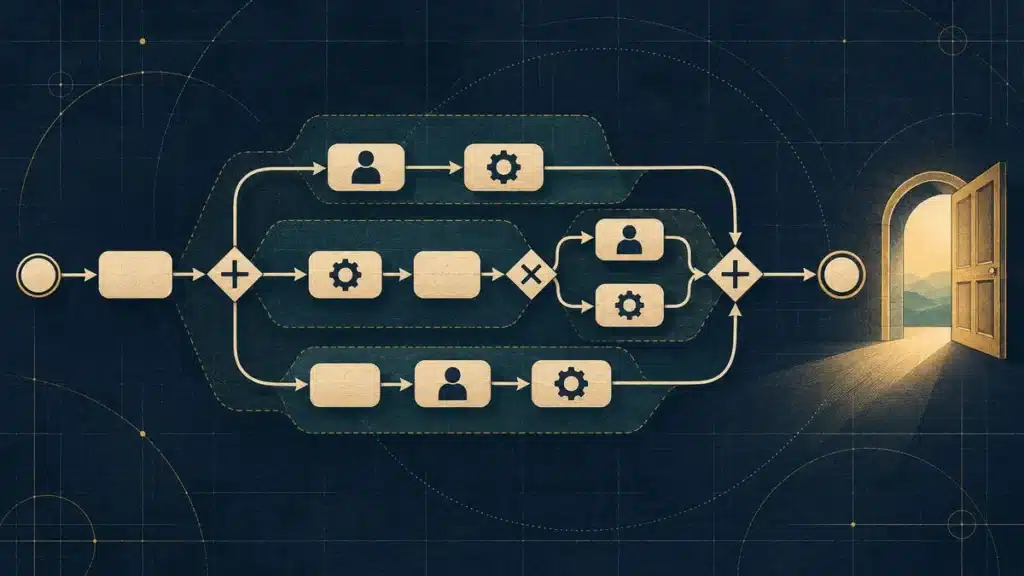
A business process often appears simple until someone tries to automate it.
“Approve the request” becomes a chain of questions. Who may approve it? What happens when the person is unavailable? Can the request be corrected? Which system owns the decision? How long should the process wait before escalating? What evidence must remain for an audit?
Most of that knowledge lives in fragments: a policy document, an application, a spreadsheet, a manager’s memory and a collection of exceptions discovered after something breaks.
Business Process Model and Notation (BPMN) gives the process a shared, precise form. Used well, it can connect a business conversation to executable workflow without pretending that a diagram removes the need for engineering judgment.
This guide explains what BPMN is, where it helps, and how seven credible open-source BPMN workflow tools differ. The objective is not to produce a universal ranking. It is to make the choice more legible.
What is BPMN?
BPMN is a standard graphical notation for describing business processes. The Object Management Group designed it to be understandable to business users while remaining precise enough for technical implementation. The current formal specification is BPMN 2.0.2.
That dual audience is the point. A process model should let an operations leader see how work moves, let a risk owner inspect controls, and let an engineer understand events, decisions, messages, tasks and failure paths.
BPMN is more than a polished flowchart. It has defined semantics and a standard XML representation. A conforming tool can store the model in a machine-readable form, although real portability still depends on which elements and vendor extensions each engine supports.
A useful BPMN model answers a practical question: what happens next, under which condition, and who or what is responsible?
Why BPMN remains useful
Workflow platforms now speak about orchestration, low-code automation, microservices and AI agents. BPMN still matters because the underlying problem has not disappeared: important work crosses people, systems, decisions and time.
Code is precise but difficult for many stakeholders to inspect. An informal diagram is accessible but often ambiguous. BPMN occupies the useful space between them.
It can make several forms of complexity visible:
- Long-running work: a process may wait hours, weeks or months between steps.
- Human participation: approvals, investigations and corrections need ownership, deadlines and escalation.
- Distributed systems: services exchange messages, fail independently and may retry work.
- Exceptions: cancellations, timeouts and rejected requests are part of the process, not afterthoughts.
- Auditability: teams may need to reconstruct which path ran and why.
The notation also creates a better review surface. A business stakeholder may not read application code, but can challenge a missing approval path or an incorrect escalation on a diagram.
That does not make the model the complete truth. Authorization rules, data contracts, operational limits and security controls still need explicit design and enforcement. The diagram helps people ask better questions; it does not answer them automatically.
How to read a BPMN diagram without learning every symbol
Continue reading after sign in.
This article is available to registered readers. Sign in to continue, or register with a basic subscriber account.